
When you talk about development, the topic of PILOTs and tax abatements inevitably comes up. There’s often a misconception here, with people thinking that this means that a development pays no taxes at all. But the fundamental belief that most people have – that PILOTs are good for developers and bad for the rest of us – holds up.
If PILOTs were the only way to get things built, maybe they would be a necessary evil. But recent projects have been completed without them, proving they simply aren’t necessary, especially for large residential projects.
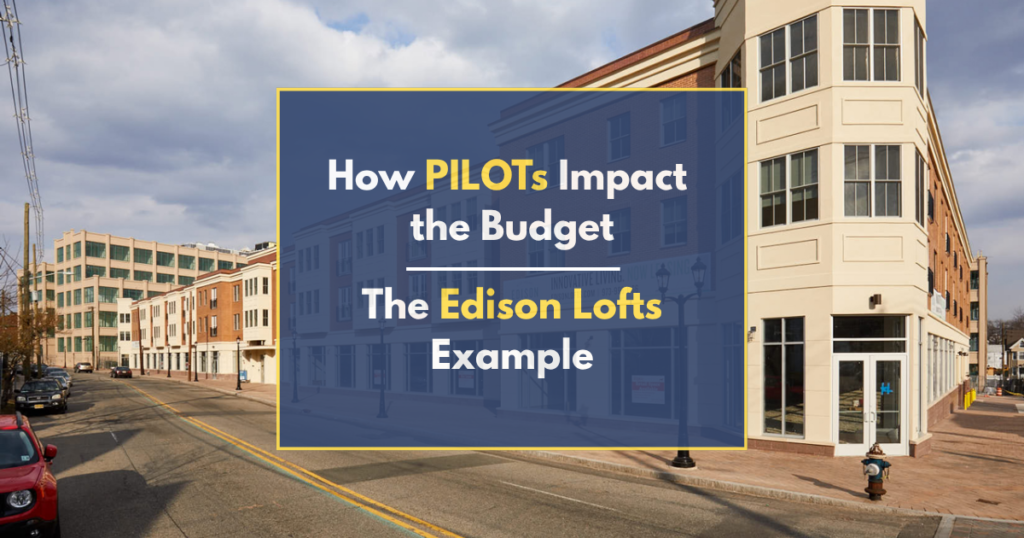
To illustrate how these deals actually work let’s run through the details of one specific agreement: Edison Lofts.
The Math Behind the Edison Lofts
If you rewind the clock twenty years, we had a big problem downtown. What do we do with old Edison Battery Factory and other blighted properties in the area. The chosen solution was to turn the old factory into luxury apartments – a strategy used successfully in Jersey City, Newark, and other cities with vacant industrial space.
To incentivize this, the developer was granted a PILOT. While agreements vary, this one stipulated that the developer pays taxes on the land itself plus an annual service charge based on their revenue from the project. That annual service charge would replace the taxes they would otherwise have paid on the assessed value of the improvements on the property.
According to the 2026 proposed municipal budget, that annual service charge was $1,326,752 last year. That sounds like a lot of money, and it is an improvement over an empty factory. But look at what the project is actually worth:
- Current Valuation: $92,110,000
- What Standard Taxes Would Be: $2,418,815
- What the Developer Actually Paid: $1,326,752
We’re getting a little over 50% of the value of that property. And that’s only part of the problem.
PILOTs Don’t Support Schools
New Jersey law mandates that a small share of a PILOT agreement (5%) is sent to the county. Typically, the remainder stays with the municipality.
That means that none of this revenue goes to support the school budget.
If you break down a standard property tax payment, a significant part of it goes to fund the school district. For this $92 million property, the school share would be about $1.5 million. The municipal share would only be about $600,000.
So if you look at this only through the lens of the town, the municipality is getting a good deal. They’re getting more than they otherwise would get. But that’s only because the town isn’t sharing what it would usually share.
Counterintuitively, this doesn’t actually hurt the school district. The district sets a tax levy and that full amount is transmitted regardless of what properties are or aren’t taxed.
But it does hurt every homeowner in town. That’s because when a property is removed from the tax rolls as part of a PILOT, the district’s tax levy is spread across the remaining properties in town. In other words, homeowners have to pay more to pick up the slack for every PILOT that’s negotiated.
When Your Taxes Go Up, Theirs Go Down
The other problem is that PILOTs don’t keep pace with the the town’s actual tax levy. They’re negotiated at a moment in time and based on projections.
This year’s municipal budget is going to include a 5-6% increase in the tax levy for homeowners. But while those taxes go up, and homeowners have no choice but to pay them, the developer’s annual service charge went down. In the proposed budget, they’ll be paying $1,209,913. A reduction of 8.8%.
Because the PILOT is tied to revenue, the developer gets a hedge against their bet. If revenue declines, so does their annual service charge. It’ll take 20-25 years for them to reach the final phase of the PILOT where they’ll be making a full tax payment – and fully absorb whatever increase is mandated for the rest of town.
Development Without the Discount
So, are PILOTs the only way to get development done? Nope. A perfect example is sitting right on Northfield Ave across from Turtleback Zoo.
A developer took an old, dilapidated hotel and turned it into the 555 Northfield apartment building and a preschool. No PILOT necessary.
While it’s not perfect – more ground-floor retail would have been great for the Northfield Ave corridor – it did one thing undeniably right: it brought in real, sustainable tax revenue.
Back in 2023, that property paid about $121,000 in taxes. Last year, that was about $627,000. That four-fold increase flows into the municipal coffers to buoy the budget, and it helps offset what homeowners pay toward the school district’s tax levy by increasing the net valuation of the town.
A Better Blueprint for Growth
We shouldn’t have to subsidize luxury developers to see our town grow. Yesterday’s news brought even more evidence of that. The Edison Lofts project was just sold for $130 million.
Think about these numbers from the developer’s initial projections from 2012:
- Approximate cost to build: $110 million
- Expected gross revenue: $10 million per year
- Expected profit: $2.8 million per year
That expected profit is after they’ve paid their annual service charge and paid debt service on the mortgage they used to build the project. That’s a pretty good return off the $40 million in actual equity that they invested.
We need to move away from chaotic, one-off deals and ad-hoc development that puts developers in the driver’s seat and leaves residents footing the bill. By prioritizing cohesive planning – starting with a dedicated town planner who looks at the big picture – we can attract the right kind of growth. Development should work for everyone in town, support our schools, and help stabilize our municipal budgets.
My commitments:
- I will not recommend any new PILOT agreements for residential projects.
- I will include a full-time planner position in the 2027 budget and fill the position as soon as possible.