
Last year, West Orange’s budget process dragged late into the fall. It was so late that the 4th quarter tax bills were delayed because they couldn’t be calculated properly.
This started with the Mayor. The budget wasn’t presented to the Council until late April. But after that, the Council engaged in a lengthy series of budget meetings that got them lost in the weeds. They didn’t come to agreement until September, and the actual budget wasn’t adopted until November 12.
This is a broken system, and at the end of last year it seemed like everyone was in agreement that the 2026 municipal budget should be moved along more expeditiously. Instead, we got the same song and dance all over again.
This is out of compliance with New Jersey law. It’s out of line with our neighbors. And it’s time for a change.
The Typical Budget Timeline
New Jersey law lays out a timeline for adoption of a municipal budget.
For a town like us with November elections, our budget runs from January to December. The Mayor is required to transmit the budget proposal to the Council by the end of February. The budget is required to be introduced by the end of March and adopted by the end of April.
South Orange had preliminary meetings on the 2026 budget in January and February. The budget was introduced March 9 and it was adopted on April 13.
Verona had preliminary meetings in February and March. The budget was introduced March 23 and it was adopted on April 20.
Montclair had preliminary meetings in February. There was a formal presentation in March followed by introduction on April 7 and adoption on May 5.
Maplewood was the only town with a significant delay. Their budget was introduced on April 7 with adoption planned for May 5. The Council ended up considering two budget amendments in May. This pushed final adoption to June 3.
Maplewood is a good example of how the Council can deliberate on the budget and make changes in a timely fashion. They didn’t spend meeting after meeting getting bogged down in the details.
The West Orange Approach
Compared to our neighbors, we followed a very different path.
Back in March, I noted that the Mayor still hadn’t shared her proposed budget with the Council. That finally happened on April 20, officially kicking off the 2026 budget process two months late.
After the initial presentation and introduction on April 27, the Council scheduled a series of budget workshops through the end of May. They were optimistic that they might get things done by then.
They did not. Instead, there was a lengthy delay in scheduling additional workshops due to vacations and availability through the summer. When the workshops resumed at the end of June, it took another four meetings to get through everything.
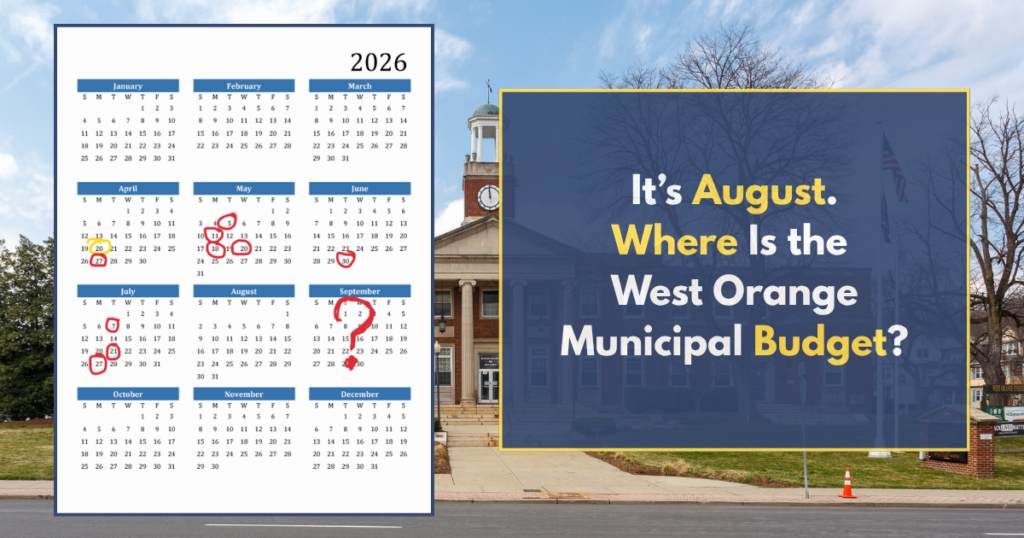
The final budget workshop was July 27, 2026. It was the culmination of nine lengthy meetings.
And at this point, they’re still not actually done. They’ve come to agreement on the numbers, but the administration still needs to present the actual budget amendment, they need to hold a public hearing, and they need to move for final adoption.
That timeline hasn’t yet been articulated, but it will likely be September before the budget gets close to the finish line. At that point, 75% of the year is over. This isn’t a budget – it’s an accounting of what we ended up spending.
Did These Meetings Serve Their Purpose?
If you ask the Council why they do this, they’ll likely point to two reasons: transparency and cost savings.
They’ve certainly achieved their goal of going through the budget in detail. But this could have been achieved in two or three meetings if they had just a) published the budget in detail, b) scheduled two to three meetings for department presentations, c) responded to questions from Council members in writing, and d) limited questions during meetings.
Instead, much of the time was wasted talking in circles. And they did not achieve the second goal: yielding significant cost savings.
The Mayor’s initial proposal was built on a $4.2 million (6.25%) increase in the municipal tax levy. The budget amendment will reduce this somewhat, but the increase will still be at least 4-5%. And most of those reductions were the result of looking at year to date actual spend and reducing the line items after the fact.
This isn’t budgeting. It’s reconciling your check book. A budget looks ahead at the next year and determines your priorities. None of these meetings yielded any structural changes in municipal operations that would save a significant amount of money year over year.
They discussed a lot of big topics. There was significant discussion over the cost of this year’s snowstorms and how DPW could have handled some of that work internally. The jitney was a hot topic at one meeting, with council members variously suggesting to a) nix it altogether or b) impose a user fee to subsidize its operations. A lot of time was spent on the legal department, and how hiring an in house attorney could save money. There were also many questions about healthcare spending and healthcare waivers, none of which could be changed at this late date.
All of these topics are big problems that need to be addressed. But doing so will require forward looking decisions to be made today that will impact future budgets.
For example, hiring an attorney to handle some of the work that’s currently being assigned to a firm could save the town money. But this would require significant runway to make happen. If we planned to hire an attorney by the end of 2026 or in early 2027, we could realize some of those savings in 2027. But even if a hire was rushed through before the end of this calendar year, there just wouldn’t be enough time to realize any significant amount of savings in the 2026 budget year.
My Commitment for 2027
Here’s my commitment for next year: get the budget done on time for the first time in a long time.
That begins with the Mayor preparing a budget. It’s also the one thing most directly in my control. I commit to preparing and transmitting a budget to the Council prior to the end of February.
Before doing so, I’ll have conversations with the Council about key priorities, potential operational changes, and a goal for the tax levy increase. We will go into the budget season with a consensus on the big issues – or at least a consensus on what the big questions are that need to be resolved.
From there, it’s up to the Council to move things along. But I will commit to making information available early and often, responding to questions from the Council and CBAB so that they can make an informed decision. And in return I will ask that they respect the timeliness of the process and not lose the forest for the trees.
They should not be micromanaging every purchase from every department. They should be focusing on the big important questions and determining the direction of the town.
Finally, I will commit to presenting a budget option that caps the tax levy increase at the rate of inflation. If operational needs suggest that a higher tax levy might be necessary, I’ll prepare two options for the Council – one capped at the rate of inflation and one that maintains the status quo. The Council can then deliberate and determine the appropriate course of action. Choices are easier to make when you are dealing with real options.
But it’s time to chart a new course for West Orange.
The current process is broken and it’s not achieving our goals. Instead, it’s consuming too much of the Council’s time – and important issues are falling through the cracks. Frankly, they don’t have the capacity to make important decisions about the future of our township when they’re knee deep in the budget weeds for months on end.