

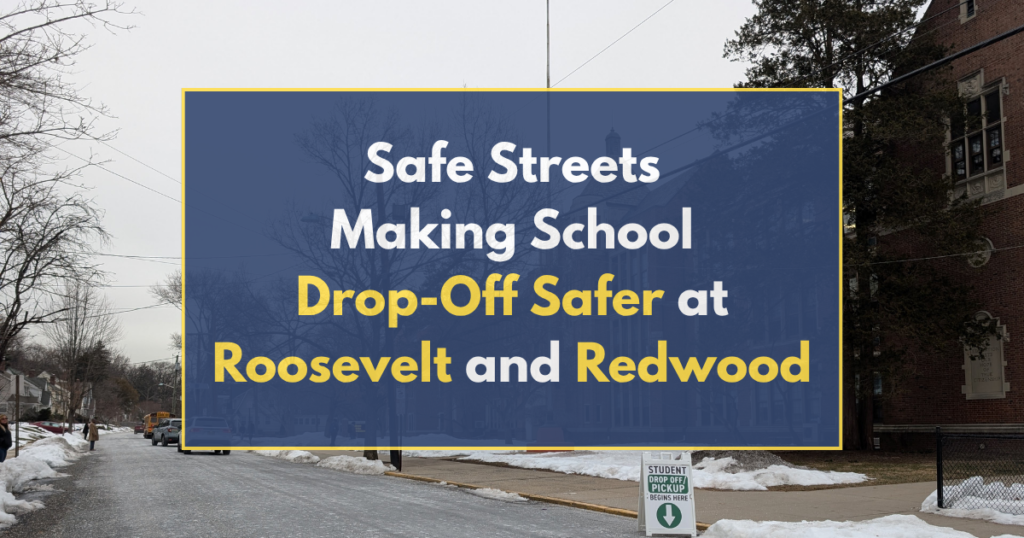
Some projects are big and they cost a lot of money. Others just require a little creative problem-solving and the will to act.
And the willingness to test things out, even temporarily, can bring progress much more quickly than trying to come up with a comprehensive solution.
A good example of that is the way that we adjusted the traffic patterns around Roosevelt Middle School this year to make morning drop-off and afternoon pick-up safer. This had been a longstanding issue for parents, but the town had failed to deliver a viable solution.
When parents started asking for change again at the beginning of this year, I spoke to Mr. Moore and Mr. Hush and we took matters into our hands. As students return to school this week, they’ll enjoy a safer and calmer drop-off experience. Looking ahead, some of these same lessons should be applied at Redwood.
What Was the Problem at Roosevelt?
Roosevelt Middle School sits along Gilbert Place. It’s a long block with a crossing guard at one end of the street. In theory, students should get dropped off on the sidewalk adjacent to the school or cross at the crosswalk at Club Boulevard.
But reality is messier. A portion of the sidewalk in front of the school is reserved for school buses. Some parents would pull past the school buses and drop their children off there. But others would come in from the other end of the street.
This would put the children on the sidewalk on the wrong side of the street and they would often jaywalk across. It was also common for parents to make illegal K-turns in the middle of the block rather than continue through.
Parents and residents routinely complained about the situation. West Orange police would ocassionally come out to monitor things, and that would temporarily lead to better behavior. But once they left it returned to normal.
There was a big meeting of all the stakeholders in the spring of 2025. The goal was to agree on changes to the traffic patterns that could make things safer. But ultimately nothing concrete materialized from this meeting, and things remained the same at the start of the 2025-26 school year.
How We Finally Addressed the Problem
In early 2026, this problem was thrust back into the spotlight when a student was hit by a car in front of the school. Thankfully, the child was not injured, but it was a reminder of the serious consequences attached to the situation.
I spoke with Superintendent Hayden Moore about the issue, and he looped in Principal Lionel Hush. We all agreed that the problem needed to be addressed – and that we couldn’t afford to let things continue as they had been.
With input from parents, Mr. Hush suggested a simple solution: block off one end of Gilbert Place and convert it into a one-way street during drop-off and pick-up. This was less disruptive than a permanent change to the street, and it could be easily monitored by existing school staff.
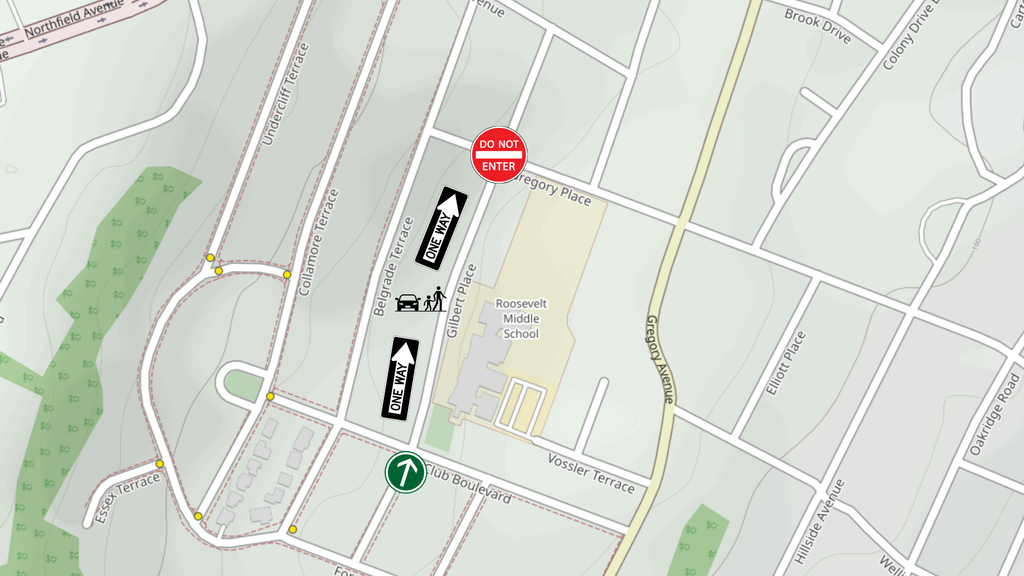
When we proposed this to the town, they pushed back. I got a call from a Councilperson who said we couldn’t do that unless there was a police officer there every day – and obviously, we don’t have the money for that. The Mayor proposed all kinds of other things, including the school district hiring its own police officer to give parents citations.
But the residents on the street agreed with us that this solution made the most sense. We insisted, and after a meeting between Mr. Moore and town leadership, we were given the green light. The police came out to monitor things for a few days, and everything went smoothly.
This was a simple and cheap solution that a) solved the problem, b) didn’t impose additional costs on the township, and c) didn’t impose undue hardships on the residents. It was a win all around.
Drop Off Issues at Redwood
Redwood has a different issue.
The school has a kiss-and-go lane for student drop-offs. However, that kiss-and-go lane can’t handle the volume of students being dropped off in the morning. By the time everyone is dropped off, the later students have missed the start of the school day.
This caused some parents to ignore the kiss-and-go completely, park on nearby streets, and walk their students in to the building. This puts more cars on the street and adds more traffic at crosswalks. Last October, the town added additional no parking zones around the school with the intent to force more parents into the kiss-and-go lanes.
To the extent that it did so, it just increased the wait time. But it didn’t stop people from parking on nearby streets. It just inconvenienced them and forced them to park further away.
That change ignored the core problem: both parents and the school need a safe, convenient, and fast way to process students being dropped off at school.
Changes Implemented for the 2026-27 School Year
The Redwood principal, Dr. Jackson, has been asking for relief. The town engineer and police visited the school, along with myself and my fellow board member Eric Stevenson, to witness the problem firsthand. I also visited Redwood in a morning in June, so I saw how slowly the kiss-and-go lane moved.
The town proposed changes, which it passed at it’s August 4th meeting. The ordinance officially created a designated drop off zone where parents can park for up to ten minutes.
The problem: this drop off zone is located on the east side of Redwood Ave opposite the school. As a result, if parents are walking their students in, they’ll need to walk to one of the crosswalks to safely cross the street.
This occupies the spaces much longer than a simple drop-off, and if it’s inconvenient it could encourage people to jaywalk across the street.
It also does nothing to alleviate foot traffic across Redwood Ave at Woodland Ave. Part of the logistical problem is that all of this foot traffic is forced to cross in front of the exit from the kiss-and-go. Every time someone crosses here, the cars in the kiss-and-go are forced to wait.
This will likely help some of the parents who were previously parking much further away to drop off their child. But it’s unlikely to expedite the entire process and get it done in time.
An Alternative Approach
If we’re going to change the traffic patterns in the area, the logical solution is not to create a temporary parking zone across on the street opposite the school.
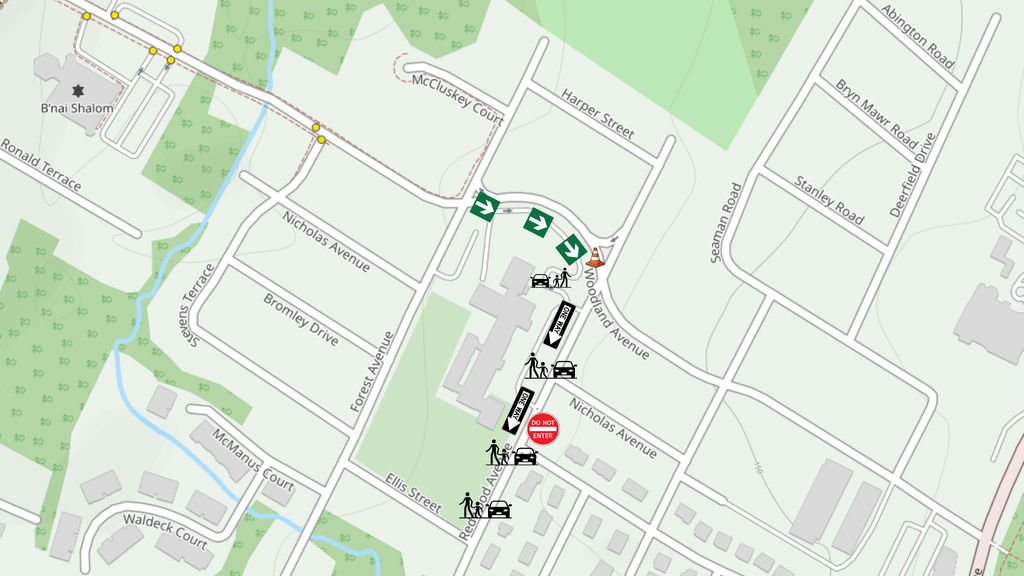
The logical solution is to allow stopping on the street adjacent to the school. The east side of the street should have no parking, stopping, or standing – at least during school hours.
This would direct parents south along Woodland Ave, where they could safely and quickly drop their child directly onto the sidewalk. The district could then modify its drop off procedure so that some students (e.g. younger students or certain special education students) would continue to use the existing kiss-and-go lane while other students (e.g. older students) would be directed to the new drop off area on Redwood.
If parents need to park to walk their child into school, then that parking should be accommodated along Ellis Street or Forest Avenue. This would allow them to walk up the sidewalk or across the field without adding additional foot traffic through a crosswalk.
This wouldn’t strictly be necessary, but blocking traffic heading north on Redwood Avenue at Cannon Street would also help. Since parents can’t stop along Redwood, this would divert them around the crosswalk at Woodland and Redwood and improve efficiency at that crossing. This would also limit traffic along Redwood to a) drop-offs and b) parents exiting the kiss-and-go.
Finally, there’s a concern about drivers turning right from Woodland Ave on to Redwood. A four-way stop is being considered, but first, we need to do a traffic study to see if the intersection is actually eligible. Another, simpler solution, would be to put a physical obstruction – like a row of planters – at the curve to force drivers to make a sharper, slower turn. The existing design encourages drivers to go faster around the corner, right into a crosswalk. Cones would also work as a short-term solution and could be used to test the concept.
Let’s Design Complete Streets for Better Behavior
This proposed design around Redwood is a good example of the fundamental beliefs of complete streets and Vision Zero. By physically designing streets to encourage safer behavior, we end up with safer streets.
But it’s a combination of physical design and accommodating rational behavior. If you force parents to use a drop-off system that takes too long or requires parking far away will, some of them will inevitably break the rules. If we want a safe, convenient drop-off process, we need to build a physical environment that naturally guides drivers to follow the rules without frustrating them.
We don’t always need expensive traffic studies to make our neighborhoods safer. Sometimes, we just need to listen to the parents and principals who live the problem every day, test out practical solutions, and make improvements over time. That’s the kind of proactive, common-sense leadership I want to bring to West Orange.
Read more about complete streets here. And if you want to see this vision become a reality, get in touch with me here.