
When you walk through your neighborhood in West Orange – whether you’re dropping your kids off at school, jogging down Pleasant Valley Way, or visiting a local business on Main Street – you should feel safe.
Yet too many of us have experienced near misses with speeding or distracted drivers. I run every morning, and I’ve had my share of close calls. And the data backs up what we feel every day. Between 2015 and 2021, West Orange averaged more than three crashes every day. Tragically, 17 people lost their lives and another 28 suffered severe injuries in that time frame.
Some of these accidents happened on I-280 as people passed through town. But many happened on our local and county roads. Pedestrians and cyclists were involved in less than 2% of these crashes – but they accounted for 41% of fatalities and 11% of serious injuries. These victims were also disproportionately children, teens or seniors. For more data and context, see our Vision Zero Final Action Plan.
This is unacceptable. As Mayor, one of my priorities will be to take the sundry plans and promises that we’ve made over the years and turn them into action – to make real improvements in infrastructure that make our streets safer for everyone in West Orange.
Understanding the Framework: Complete Streets, Green Streets, & Vision Zero
To make our streets safer, we have to design them intentionally around three proven concepts that are complementary:
- Complete Streets. Roads should be designed for everyone – pedestrians, cyclists, bus riders, and people of all mobility levels – not just fast-moving car traffic. This requires physical improvements in infrastructure like crosswalks, sidewalks, bike lanes, and accessible bus shelters.
- Green Streets. This infrastructure should also include sustainable design elements – such as rain gardens, shade trees, bioswales, and permeable pavement – so that road design also contributes to the capture of stormwater, reduces local flooding, and improves air quality.
- Vision Zero. This is a commitment to eliminating all traffic fatalities and severe injuries on our roadways. It’s built on a safe system approach – which means that human error is inevitable, but fatal crashes are preventable if our roads are designed to protect vulnerable human bodies. Design elements can slow traffic and save lives.
Over the years, we’ve explored all of these options and formalized them into plans and the town’s governance structures. But actual results have been slow to materialize, and many of the issues documented over the past decade have gone unaddressed.
Where We’ve Been and Where Progress Is Stalling
A number of feasibility studies and concept plans have been prepared in the recent past.
In 2013, the town worked with the Rutgers and the Rahway River Watershed Association to prepare a Green Streets Feasibility Study. This identified potential types of improvements and highlighted where they would be appropriate throughout town. In light of the recent storms – and flooding throughout town along the Rahway River – this seems more important than ever.
In 2015, a Rutgers student at the Bloustein School worked with the town to create a Complete Streets Concept Plan. This plan scored the walkability of major roadways, and it flagged Pleasant Valley Way, Prospect Ave, and Northfield Ave as some of the least walkable roads in town. It also offered specific recommendations for improvements.
In 2019, the town’s Master Plan was updated and it incorporated many of these recommendations. It recommended additional sidewalks, traffic calming measures along Main Street, improvements along Northfield Ave by the zoo, better connectivity to Essex Green, and improved crossings across Route 280.
In 2023, the town finalized it’s Vision Zero Action Plan. This included a crowd-sourced assessment of the town’s infrastructure as well as data about accidents over the preceding decade. It identified many of the same roads and intersections as problems and included a variety of both low cost and high cost solutions.
There have been some improvements and victories. The Pedestrian Safety Advisory Board was formed to raise awareness and advocate on these issues. A traffic light was installed at Alisa Drive up by the high school. Traffic calming measures were implemented along Main Street by the Edison museum. A series of grants are queued up to improve crosswalks near schools, add sidewalks near Gregory and Lowell Ave, and improve sidewalks on Washington Street.
But many issues remain. The Northfield Ave corridor is largely unchanged, despite new development, and no improvements have been made to the intersection with Pleasant Valley Way. Essex Green is still cutoff from the rest of town, and if you get there on a bus it’s still difficult to walk your way back towards the library. Gregory Ave, particularly the area near Mitchell, remains one of the most complained about streets in town. Bikes are an after thought throughout town and it’s like pulling teeth to get the town to support safer drop off routines at our schools.
We have no shortage of good ideas. We just need the will to make them a priority – and a reality.
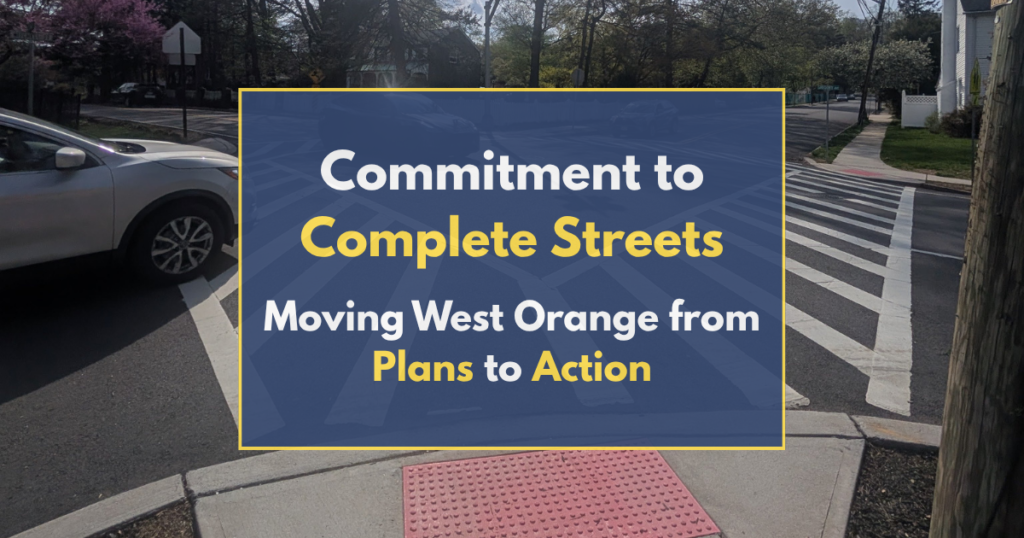
My Commitment to Complete Streets
As Mayor, I will be committed to moving the ball forward on complete streets. We can’t make over the town overnight, but we can pursue a variety of short and long term actions that will meaningfully improve safety and accessibility throughout West Orange.
Some cheaper, short term examples include:
- Repainting faded crosswalks and speed humps throughout town, like those on St. Cloud Ave
- Identifying new places for crosswalks, like Korwel Circle / Aspen Road, Wilson Terrace, and Rollinson Street
- Using planters or temporary bollards to daylight intersections
- Implementing temporary solutions before committing to permanent infrastructure upgrades
- Trimming brush along sidewalks and roadways where it is overgrown, or educating property owners on the need to do so
In the medium term, we must:
- Identify roads appropriate for a road diet, like sections of Pleasant Valley Way or Eagle Rock Ave
- Inventory bus stops in town and add, replace or improve shelters where necessary
- Inventory bike racks in town and add them to municipal properties and/or streets where appropriate
- Advocate with the county to add sidewalks and/or bike lanes along major county roads to connect neighborhoods
In the long term, we can use grant funding and/or capital funds to:
- Add sidewalks to local roads where appropriate, prioritizing school walking routes like near. Mt. Pleasant and Liberty
- Add traffic lights to problem intersections, like Mitchell and Gregory
- Redesign sidewalks in busy areas to include curb cuts and pedestrian islands
- Ensure all new development contributes to these priorities and improves safety and accessibility
I’ve run up and down every street in this town, and I’m out there every day. I see my friends and neighbors out there, too. We all deserve safe, accessible streets – and we can make them happen one step at a time.
Get in touch with the campaign and let me know what kinds of improvements you’d like to see here.