

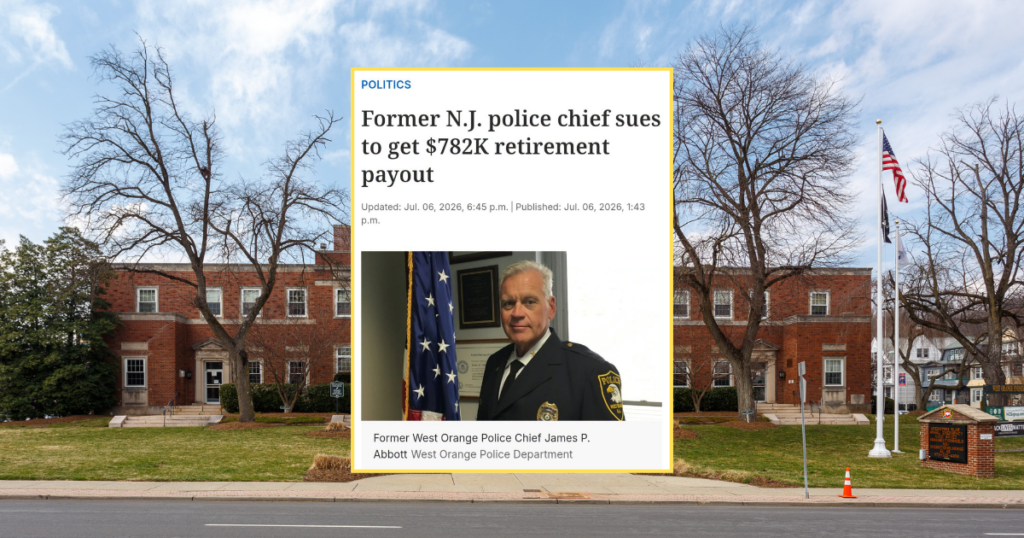
In February, it was reported that West Orange’s former Chief of Police, James Abbott, was due to receive a $780k payout for accumulated leave at retirement. This is an obscene amount and it raised questions about how this could happen – and whether there was anything that could be done to avoid paying it.
Since then, Abbott has not been paid. But he recently filed a lawsuit demanding that the town make that payment. While asking questions and providing oversight is prudent, we’ve now been drug into legal proceedings that could make this whole episode more costly. And there’s no indication that we have a sound legal argument for avoiding making the payment.
Focusing our attention on this particular payment misses the point. The questions we should be asking are – a) is there the potential for similar liabilities in the future and b) what can we do to avoid them?
Is Chief Abbott Entitled to the Full Payout?
At first glance, the amount seems incredible. The state passed a series of laws to try to reign in these kinds of payments, and some people have pointed to these laws claiming that this particular payout is illegal.
But if you understand those laws, the facts of the case make this is a murkier question. It probably isn’t illegal. It’s just poor decision making on the part of the past town administrations.
These laws made a few key changes:
- Sick leave payouts are limited to $15,000, unless that time was accrued before the effective date
- Sick leave payouts could only be made at the time of retirement
- Vacation could only be accrued for one year. In the second year, it was “use it or lose it.”
A document was leaked to the press that contained the breakdown of Abbott’s accumulated time.
That document indicated that Abbott had accrued 544 hours of vacation time. This equates to 68 days. A letter from the town’s labor attorney, included as evidence in the lawsuit, confirms that Abbott was granted 34 vacation days per year. This amount is thus equal to two years – and permissible under the new law.
That document also indicated that he had only accrued 105.5 hours of sick time. According to the town’s policies, this was valued at $8,268.43. The labor attorney’s letter cited a different amount (177.3 hours, valued at $12,573.40). In either case, this is under the $15,000 limit – regardless of whether it was accrued before the effective date of the law.
Finally, Abbott filed for retirement with the Police and Firemen’s Retirement System (PFRS), so the timing of the payment for accumulated sick leave is permissible. Although he reportedly took a job elsewhere, that job is not covered by PFRS and he has “retired” in the way that the law means.
Collectively, these two amounts are worth $88,345.60 (vacation time) plus $12,573.40 (sick leave) = $100,919.00. That’s a large figure, but it’s not a crazy amount for a long serving police chief.
Where’s the Other $680,000?
If the total payout is $780,000, and vacation and sick leave only total $100,000, what makes up the remainder?
The leaked document contains five other categories of accumulated leave: Garcia time, snow days, overtime, seniority days, and limited time due. The first two categories are small amounts (7.5 hours and 17.5 hours).
Overtime is a larger category (467 hours / $75,840.80), and the labor attorney’s letter raises some questions about when this was earned. Potentially, some of this could be disqualified, but likely a small amount.
The next largest category is seniority days: 1352 hours valued at $219.564.80.
Seniority days were a negotiated benefit provided to employees until January 1, 1996. At that point, they were eliminated through collective bargaining for new employees. Abbott, who was initially hired in 1980, would have been grandfathered in to earning these days. According to the labor attorney’s letter, he would have started accruing seniority days in 1985 and he would have accrued the maximum (6) seniority days each year since 2010. This amount is not in question.
The final category is limited time due. It’s unclear exactly what this category is, but various explanations from the administration seem to suggest that it is converted vacation time – either unused time from an earlier year or unused time during a period when the Governor had declared a state of emergency (which state law does allow employees to accrue).
On its face, it would seem that simply converting unused vacation time to another category of leave would be in direct violation of the law limiting the accrual of vacation time to one year. However, the 2022 Office of the State Comptroller’s report, “A Review of Sick and Vacation Leave Policies in New Jersey Municipalities” suggests otherwise.
The goals of the 2007 and 2010 laws may be undermined by conversion of and payments for annual vacation leave.
PERC is the primary entity that has interpreted the vacation leave provisions of the 2010 law. PERC […] has concluded that the vacation leave statutes do not bar the conversion of vacation leave into other forms of leave and do not bar financial compensation for unused vacation. PERC has held that the conversion of vacation leave to another form of leave that does not expire and may be carried indefinitely is not prohibited by N.J.S.A. 11A:6-3(e), nor the 2007 or 2010 laws.
The underlying PERC decision is based on the premise that the law does not expressly prohibit the conversion of accumulated leave – and law must be interpreted strictly. It doesn’t matter what the intent was. It matters what it says.
Absent a clear argument for why Limited Time Due would be illegal – Abbott would also be entitled to this $390,937.40.
The Impact of the Final Salary
Another element here is the hourly rate at which this time is paid out. It’s paid at the employee’s final hourly rate – which may be much higher than when the time was accrued.
To some extent, this is normal. An employee’s salary rises through the course of their career. But in the case of Abbott, that salary increased by over 50% in the final five years.
In 2020, his salary was less than $200,000. His final contract, taking effect in 2021, drastically increased that amount. By the time he retired, his total compensation was in excess of $300,000.
That increase leads directly to an increase in this accumulated leave payment. The current hourly rate ($162.40) leads to a final payment of $780,000. If the hourly rate was only $100.00, slightly higher than his salary five years ago, the payment would be close to $480,000.
That’s still a large figure. But to put it bluntly: that final salary increase cost the town an extra $300,000 in this accumulated leave payment.
Are These Things Outlined in a Contract?
The final issue is that neither “Limited Time Due” nor “Snow Days” are clearly spelled out in any of the town’s contracts or policies. This leads to another angle of questioning as to whether it’s appropriate to pay this out.
It may seem logical that you’re only contractually entitled to what’s written in your contract, but this is illustrative of an important topic in labor law: past practice.
If something is clearly understood by both labor and management to be a term and condition of employment, and it has been so over a long period of time, then it essentially is a part of the contract. Even if it hasn’t been written down.
Both of these categories of time existed in the past, and they were documented in the town’s timekeeping system. They sound a lot like an established past practice – which would be as enforceable as any other contract provision. The administration can stop using these moving forward, but they can’t simply void what’s already been granted.
At the end of the day, this all sums up to: the payout is ridiculous, but there’s no clear argument that it’s illegal or void in any way. As a result, the town will end up paying it – now or later.
What Should We Be Worried About?
If that’s the case, continuing to hold up this particular payout – or others, as occurred at the July 7 council meeting, is short sighted. And doing so in direct opposition to advice from the town’s labor counsel is irresponsible. The end result will simply be costly litigation that the town loses.
The two questions we should be focused on are:
- Are there other potential liabilities out there?
- If so, how can we limit these moving forward?
The first question deserves a thorough review by the administration, and this is something I would do immediately upon taking office. It’s a simple matter of looking at accumulated leave to see who has accumulated significant numbers of seniority days and/or limited time due.
But a cursory review of the current proposed budget shows that there are at least two senior employees who began their employment prior to 1996 – and are thus accumulating seniority days. They may not end up with a similarly sized payout, but that is one key factor that could lead to a very large one.
If that’s the case, we then need to consider how to limit these liabilities moving forward. Here are a series of priorities that could be negotiated through individual employment contracts and/or collective bargaining agreements:
- Limits on the total amount of time in other categories that are eligible for payment, after which any days would be forfeit.
- Limits on the hourly rate that can be used for calculating payment of accumulated leave.
- Limits on the amount to be paid out in any given year, with larger payouts split over two or three years.
Finally, the practice of granting additional categories of leave (i.e. limited time due) should be curtailed and/or eliminated. At the most recent council meeting, the Business Administrator stated that no one was accruing limited time due or snow days moving forward, which is a step in the right direction.
We can’t afford to look backwards and fight a losing battle. We need to look forward – learning from these mistakes and taking appropriate action to prevent similar ones from happening in the future.